
Wallpaper is one of the easier materials to miscalculate—and one of the hardest to fix mid-job. Buy too little and you can’t get a dye-lot match. Buy too much and you’re absorbing cost. The key variables—roll size, yield, and pattern repeat—catch most installers off guard the first time.
Here’s the method professionals use.
The Core Formula
Rolls needed = Total strips required ÷ Strips per rollWhere:
- Strips required = Strips to cover the full wall perimeter at the roll width
- Strips per roll = How many strips you can cut from one roll, accounting for pattern repeat waste
Step 1: Measure Your Walls
Add up the width of every wall you’re papering. This is your perimeter. Multiply by ceiling height to get your gross wall area.
Example: Papering all four walls of a 12 × 14 ft room with 9 ft ceilings:
Perimeter = 2 × (12 + 14) = 52 linear feet
Gross wall area = 52 × 9 = 468 sq ft
Important: Do not subtract doors and windows from your perimeter.
This surprises a lot of estimators who are used to paint calculations. With paint you deduct opening area because you’re not buying it twice. With wallpaper, strips run continuously from ceiling to baseboard—they hang over doors and windows and are trimmed after installation. The strip count is driven by how many strips span the perimeter, not by net square footage. A door in the middle of a wall still requires a full strip on each side of it, and those strips cost the same roll material regardless.
Subtracting door and window widths from your perimeter would undercount strips and leave you short on the job.
Step 2: Know Your Roll Size
Standard roll dimensions vary by origin:
| Type | Width | Length | Total Area | Usable Area |
|---|---|---|---|---|
| American single roll | 27 in (2.25 ft) | 27 ft | ~61 sq ft | ~50–55 sq ft |
| European double roll | 20.5 in (1.71 ft) | 33 ft | ~56 sq ft | ~46–50 sq ft |
| Wide format | 36 in (3 ft) | varies | varies | ~85% of total |
“Usable area” is lower than total because every roll loses material to trimming, butt-jointing, and cutting to fit ceiling and baseboard. Without any pattern to match, expect 85–90% yield.
When entering your roll specs in an estimating tool, you’ll typically set roll width, roll length, pattern repeat, and waste factor. Here’s what those fields look like in SiteScope:
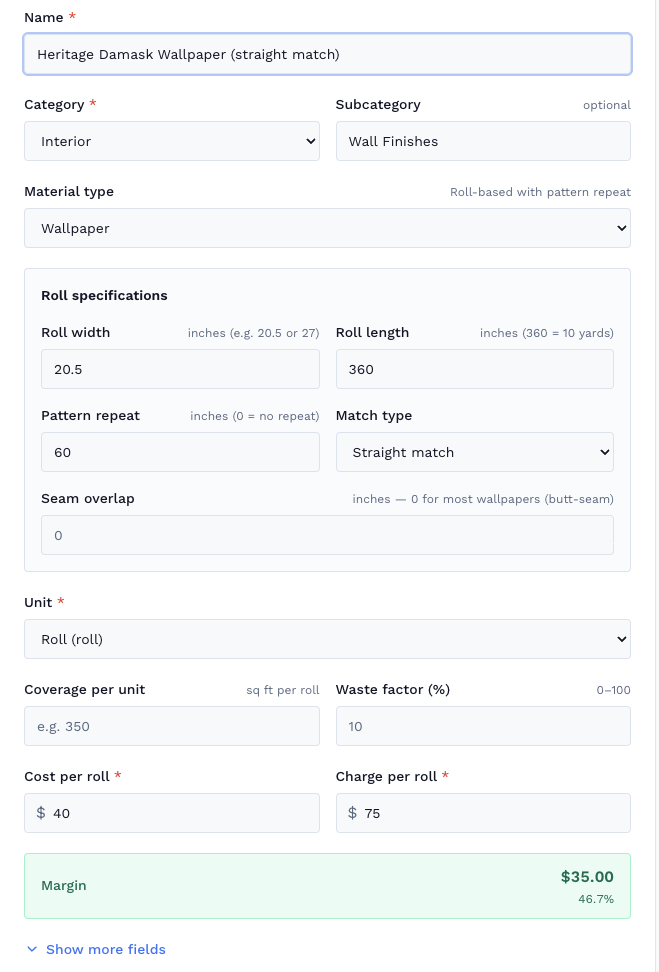
In this example: 20.5” wide European roll, 360” (30 ft / 10 yards) long, 60” pattern repeat, butt seam (0” overlap), 10% waste. The cost and charge fields drive your estimate margin automatically.
Step 3: Calculate Strips Needed
Number of strips to cover your perimeter:
Strips needed = ceil(Perimeter ÷ Roll width)Example with 27-inch American rolls:
Roll width = 27 ÷ 12 = 2.25 ft
Strips needed = ceil(52 ÷ 2.25) = ceil(23.1) = 24 strips
Note: These formulas assume butt seams—strips are butted edge-to-edge with no overlap. Most residential wallpaper is installed this way. If you’re using an overlap seam (common with commercial vinyl or textured coverings), the usable strip width is narrower than the roll width, which increases your strip count. See Butt Seam vs. Overlap Seam for the adjusted formula.
Step 4: Account for Pattern Repeat
This is the step that catches people. A pattern repeat means each strip must start at a specific point in the pattern’s cycle—so when you butt two strips together, the pattern lines up across the seam.
Every time you cut a new strip, you may need to advance into the roll to find the right starting point. That wasted paper between the cut point and the next matching point is your repeat waste.
Three types of match:
| Type | Description | Typical Waste |
|---|---|---|
| Straight match | Pattern aligns horizontally on every strip | 0–5% |
| Drop match (half-drop) | Pattern offset by half the repeat on alternating strips | 15–25% |
| Random / no match | Textured or non-directional pattern | ~5% |
How to calculate strip length with repeat:
Strip length = ceil(ceiling height ÷ repeat length) × repeat lengthExample: 9 ft ceiling, 18 in (1.5 ft) repeat
Strip length = ceil(9 ÷ 1.5) × 1.5 = 6 × 1.5 = 9.0 ftNo waste here—9 ft divides evenly into 1.5 ft repeats.
Example: 9 ft ceiling, 24 in (2.0 ft) repeat
Strip length = ceil(9 ÷ 2.0) × 2.0 = ceil(4.5) × 2.0 = 5 × 2.0 = 10.0 ftEach strip needs 10 ft of material to start at a repeat boundary, even though the wall is only 9 ft. You waste 1 ft per strip.
Trim reduces your strip length
Baseboard and crown molding are installed over the wallpaper, so your strips end just below the crown and just above the baseboard — not at the raw floor and ceiling. That shorter usable height can knock an entire pattern repeat off the strip length, which means more strips per roll and fewer rolls overall.
Formula:
Usable height = Ceiling height − baseboard height − crown height
Strip length  = ceil(usable height ÷ repeat length) × repeat length
Example: 9 ft ceiling, 25 in (2.083 ft) repeat, 6” baseboard + 3” crown
Without trim:
Strip length = ceil(9.0 ÷ 2.083) × 2.083 = ceil(4.32) × 2.083 = 5 × 2.083 = 10.42 ftWith 9” of trim:
Usable height = 9.0 − 0.5 − 0.25 = 8.25 ft
Strip length  = ceil(8.25 ÷ 2.083) × 2.083 = ceil(3.96) × 2.083 = 4 × 2.083 = 8.33 ft
One full repeat shorter. On a 27 ft roll that’s the difference between 2 strips and 3 strips per roll — a meaningful savings on a pattern-heavy room.
Step 5: Calculate Strips Per Roll
Strips per roll = floor(Roll length ÷ Strip length)No repeat:
Strips per roll = floor(27 ÷ 9) = 3 strips per roll24-inch repeat:
Strips per roll = floor(27 ÷ 10) = 2 strips per rollThat 24-inch repeat reduced your yield from 3 strips to 2 per roll. Same room, 50% more rolls.
Step 6: Final Roll Count
Rolls = ceil(Strips needed ÷ Strips per roll) + bufferNo repeat:
Rolls = ceil(24 ÷ 3) = 8 rolls24-inch repeat:
Rolls = ceil(24 ÷ 2) = 12 rollsThe Professional Buffer Rule
Always order at least 1 extra roll beyond your calculation. Sometimes 2.
Here’s why:
- Dye lots: Wallpaper is printed in batches. The next production run may not be an exact color match. Order all rolls from the same dye lot in one order.
- Damage: A bad seam repair, an adhesive bleed-through, or a dropped roll that gets wet can cost you a full roll mid-job.
- Measurement error: A wall that turned out to be 6 inches wider than measured can require a full extra strip.
For patterns with repeats over 18 inches or bold graphic patterns, order 2 extra rolls.
Quick Reference Table
| Room Size | Ceiling Height | No Repeat | 18” Repeat | 24” Repeat |
|---|---|---|---|---|
| 10 × 10 ft | 8 ft | 5–6 rolls | 6–8 rolls | 7–9 rolls |
| 12 × 14 ft | 9 ft | 8–9 rolls | 10–12 rolls | 12–14 rolls |
| 14 × 16 ft | 9 ft | 10–11 rolls | 12–14 rolls | 14–16 rolls |
Based on 27” × 27 ft American single rolls. Add 1–2 rolls to each figure as a buffer.
Use our Wallpaper Calculator to get an exact roll count for your room—enter your dimensions, roll size, and repeat, and the math runs automatically.
For installers tracking multiple rooms or projects, SiteScope calculates rolls per wall from a 3D scan, with your roll size and pattern repeat already factored in.